


Five years ago, a young sales manager named Troy got an assignment that made him uncomfortable.
His company — a mid-sized precision industrial fabricator — had been coasting on repeat orders from a handful of longtime customers for years. Sales were down. New business was nearly nonexistent. The owner handed Troy a vague mandate: "Get the website updated."
Troy didn't really know what that meant. He didn't know what to ask for, what success looked like, or whether a new website would actually move the needle on the sales problem he was staring at. He just knew the site looked dated and that something had to change.
So he did what any of us would do. He Googled it.
He found weCreate, read through the site, and got on a call with me. What he expected was a pitch for a new design. What he got instead was a completely different way of thinking about his sales problem.
I walked Troy through something that had become obvious to me after years of working with manufacturers, but that stopped him cold: your website is not a brochure you send people to. It's a salesperson — one that works 24 hours a day, never calls in sick, and can be talking to dozens of qualified buyers simultaneously. More importantly, I told him, the buyers in his industry were already searching online for exactly what his company made. Every day that his company didn't appear at the top of those searches was a day a competitor got that call instead.
Troy bought in. We rebuilt the site, launched a focused industrial SEO program, and got to work.
Over the next four years, that program generated $2.8 million in tracked leads in the most recent year alone — inbound inquiries from buyers Troy never would have reached through cold calls or trade shows. Then, about a year ago, something happened that nobody on that first call could have predicted: they closed a deal with SpaceX.
Today, Troy's company is turning away business because they can't keep up with demand.
That's not a marketing story. That's what happens when a manufacturer becomes genuinely visible to the right buyers at the right moment.
If you're reading this and wondering whether something like that is possible for your company — keep reading. The rest of this guide explains exactly how industrial SEO works, what actually drives results, and how it compares to every other option available to you.

Search engine optimization for industrial manufacturers is the combination of on-site improvements and off-site authority building that causes your website to appear at the top of Google — and increasingly AI-powered search tools — when a buyer searches for what you make or do.
In plain terms: your ideal customer types something into Google. Industrial SEO determines whether they find you or your competitor.
According to Semrush's B2B Marketing Statistics report, 66% of B2B buyers use organic search to research suppliers before ever contacting a sales rep. And Forrester's State of Business Buying research found that buyers are already 70% through their decision process before they reach out to a vendor. If you're not visible in search at that moment, you simply don't exist to them.
The median SEO ROI for manufacturing companies is 813% — meaning for every dollar invested, manufacturers statistically get back more than eight times that investment. That's not a marketing claim. That's an independently documented industry benchmark.
Every industrial SEO program lives or dies on two interconnected disciplines. Understanding both — and the relationship between them — is the foundation of everything else.
On-page SEO is the architecture of your website. It's how your pages are structured so that Google and other search engines can clearly understand what each page is about, what searches it should appear for, and how valuable it is to a real reader.
The most important on-page elements for industrial manufacturers:
The most common on-page mistake we see: Industrial manufacturer websites that are entirely self-promotional — "we offer this, we provide that" — without providing genuinely useful technical information. The companies that rank and convert are the ones that also educate. When buyers can see you demonstrably understand their process, they trust you with their parts.
Real Result: Progress for Industry (Industrial Coatings)
Progress for Industry had zero web leads despite serving Fortune 500 clients on their roster. Their site simply didn't exist for the terms their buyers were searching. We targeted niche keywords like "FDA-compliant industrial coatings," restructured the site around a content hub model, and built backlinks through contributions to industry trade publications. The result: multiple daily inbound leads and $3.5M/year in new revenue — including a multi-year contract with a global aerospace firm.
Off-page SEO is the part most manufacturers underestimate — and the reason most DIY SEO efforts eventually stall.
Even a perfectly optimized website will struggle to rank for competitive industrial terms without external authority signals — primarily backlinks. A backlink is a link from another website pointing to yours. In Google's evaluation model, each quality backlink functions as a credibility vote: another established site is telling its visitors — and Google — that your content is worth their attention.
Not all backlinks carry equal weight. The factors that determine a link's value:
You can assess your own site's backlink profile — and benchmark against competitors — using two tools we rely on:
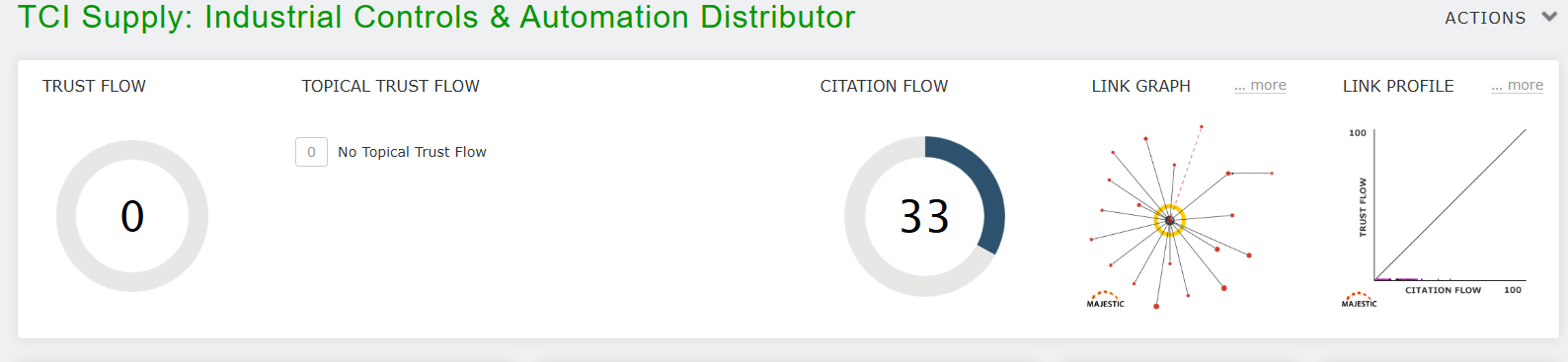
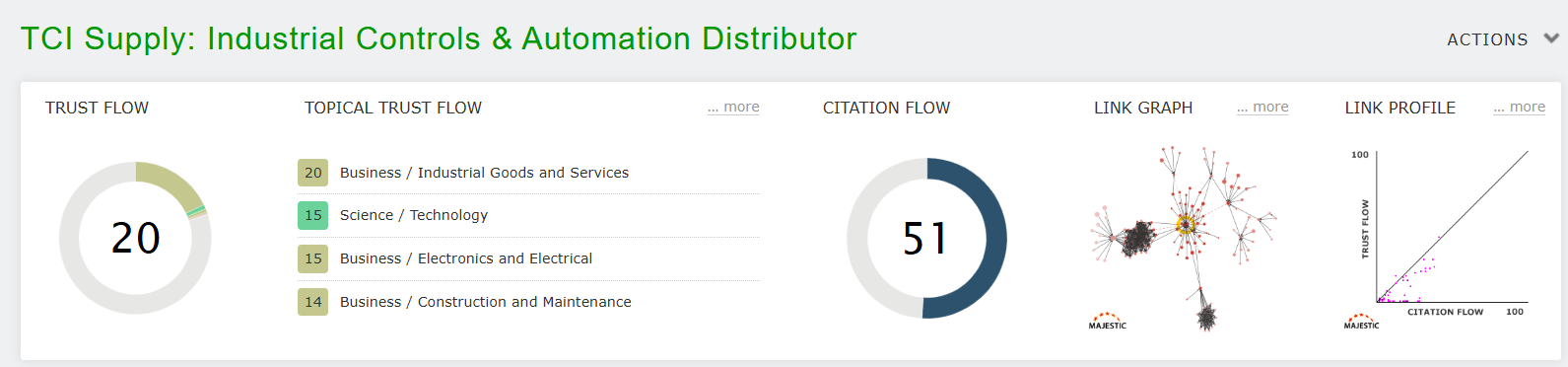
This section matters because the market is saturated with firms selling things that look like SEO but aren't.
There was a time when automated tools could generate thousands of low-quality backlinks and briefly boost rankings. That era is over. Google's quality evaluators
now assess the relevance, authority, and topical alignment of every inbound link. Automated link schemes don't just fail — they can trigger manual penalties that erase rankings you've spent years building.
Be skeptical of any firm that pitches you a flat monthly package with "X social signals, X press releases, X directory submissions." These packages are designed around activities that are easy to automate and easy to report — not around the backlink authority and content depth that actually move industrial search rankings.
Social signals show correlation with rankings, but not causation. After hundreds of controlled tests, we've never demonstrated a direct causal relationship between social media activity and search rankings. What we have found: companies with strong social presences tend to also invest in content creation and link building — which are causal ranking factors. Social media is valuable for brand awareness and relationship building. It is not an SEO strategy.
This is the most important expectation to set correctly. Industrial SEO is a compounding investment. Most manufacturers see meaningful keyword movement at 3–6 months. The full compounding effect — where new content builds on existing authority and rankings multiply across hundreds of keyword clusters — becomes clearly visible at 12–18 months and continues building from there.

This is the section most industrial SEO guides haven't caught up to yet — which is precisely why it belongs here.
Tools like Google's AI Overviews, ChatGPT, Perplexity, and other AI search tools are now actively used by engineers and procurement managers to identify and shortlist suppliers.
Forrester found that 95% of B2B buyers expect to use generative AI in their purchasing process. This isn't coming — it's happening in your buyers' offices right now.
What makes an industrial manufacturer show up in AI-generated results?
The practical takeaway: everything that has always made industrial SEO effective — real expertise, quality backlinks, specific technical content — now also makes you visible in AI-generated search results. The surface area has expanded. The fundamentals haven't changed.
This is the comparison most manufacturers need before they commit to a direction. We've used and tested every channel listed below — both for weCreate's own growth and for clients across dozens of manufacturing verticals. Here's the honest, data-backed picture.
The Close Rate That Changes Everything
Here's the number most manufacturers don't know: SEO-generated leads have a 14.6% close rate. Outbound methods — cold calling, direct mail, trade show follow-up — average 1.7%. That's not a marginal difference. That's an 8x gap in sales efficiency.
The reason is straightforward. A buyer who finds you by searching for exactly what you make and clicking your listing is already qualified. They need what you offer, they're actively looking, and they found you first. A cold-called prospect is none of those things.
Outsourced cold calling is a legitimate option — but the timeline and investment are rarely presented honestly. A prospecting contractor with manufacturing experience typically runs $40,000–$70,000 per year. The leads they generate are rarely ready to place orders — they're early-stage, relationship-building contacts. Based on a realistic funnel, it typically takes 2–3 years and $100,000+ of investment before you see meaningful closed revenue from a cold calling program.
If you can sustain that investment, it can build a solid book of business. The question is whether you want to spend that capital and time on a channel with a 1.7% close rate, or on one with a 14.6% close rate that builds a permanent digital asset that keeps working whether you're paying for it or not.
We're not anti-tradeshow. For certain manufacturing verticals — particularly where hands-on product demonstration matters, or where the relationship is the product — trade shows have genuine value. But the math on pure lead generation ROI is difficult to defend.
When you account for booth fees, travel, lodging, staff time pulled from production, and lead follow-up costs, the cost per qualified lead from a trade show is consistently higher than digital alternatives. The more important point: a tradeshow spend is ephemeral. When the lights go out, the investment is gone. SEO builds a permanent digital asset that compounds in value every month you maintain it.
The manufacturers we work with most successfully don't abandon trade shows — they reduce their frequency and reallocate that budget toward the digital infrastructure that makes every trade show conversation more valuable: buyers who already know your name when they walk up to the booth.
ThomasNet, MFG.com, RFQUSA, and similar directories are genuinely useful — particularly early in a digital marketing program when your own site has limited authority. The important distinction: a directory listing drives buyers to their platform first, then to you. SEO drives buyers directly to your website.
That distinction compounds over time. A buyer who finds you through ThomasNet may evaluate you alongside 40 competitors on the same page. A buyer who Googles "ITAR precision machining Pennsylvania" and finds your website first is already on your turf, reading your content, seeing your certifications, and forming a preference — before they've contacted anyone else.
We recommend industrial directories as an authority-building layer — particularly for the do-follow backlinks platforms like RFQUSA and Tristate Manufacturers provide — not as a replacement for organic search visibility.
For a manufacturer doing $1M–$10M in revenue that wants to double over two years, here's how we'd allocate a realistic annual marketing investment:
That budget may feel significant. Consider the alternative: a single outsourced cold calling contract runs $40,000–$70,000 per year with no digital asset built, a 3-year payoff runway, and a 1.7% close rate. The math isn't close. Also consider that not every manufacturer has a goal to double in 2 years, so you may decide not to pursue all of these techniques simultaneously.
For industrial manufacturers, the highest-value backlink sources fall into three tiers.
Links from PMPA, NTMA, AMT, your regional MEP center, and the Manufacturer & Business Association carry significant Topical Trust Flow in the "Business/Industrial Goods and Services" niche — exactly where you want it. Membership listings, speaking engagements, and contributed articles in these networks are among the highest-value link-building activities available to any manufacturer.
The most scalable long-term link acquisition strategy is creating technical content so genuinely useful that trade publications, industry blogs, and peer organizations naturally reference it. Process guides, material comparison charts, design-for-manufacturability resources, and tolerance references earn links organically — while simultaneously driving direct search traffic.
The industrial marketing space is crowded with generalist agencies that add "manufacturing" to their services page without any real industry knowledge. Here's how to separate the legitimate firms from the rest.
1. They measure success in rankings, traffic, and leads — not activity counts.
If two months pass without meaningful keyword movement, that warrants a direct conversation — not a report showing how many social posts went out.
2. They understand your buyers, not just keywords.
An industrial SEO firm should speak intelligently about how procurement managers, engineers, and supply chain professionals search in your specific vertical. Generic keyword research doesn't work for technical industrial buyers.
3. They have genuine manufacturing case studies.
Ask to see documented results from manufacturing clients specifically — not e-commerce or local services case studies. Industrial buying cycles are long, technical, and relationship-driven.
4. They distinguish between the active SEO phase and the maintenance phase.
A credible firm will be transparent about when you're in active ranking-building mode versus defending and expanding existing positions. You should not be paying active SEO rates indefinitely once target positions are achieved.
5. They don't just accept your keyword list.
Your instincts about buyer search behavior are a valuable starting point. An experienced firm will validate those terms against real search volume, assess competition levels, and identify high-intent adjacent opportunities you haven't considered.
The manufacturers winning consistently in 2026 aren't doing one thing well in isolation. They're running a coordinated program: a technically sound, keyword-focused website; ongoing SEO building authority across niche capability keyword clusters; directory listings that are current and clean; technical content that answers real buyer questions with genuine depth; and a commitment to the long game — because that's where the compounding happens.
Troy's company didn't close a SpaceX deal because they ran a campaign. They closed it because over four years they built the kind of search visibility and online credibility that puts you in front of buyers you'd never reach through cold calls or trade shows alone. When SpaceX came looking for a supplier, they found the right one.
That's what industrial SEO, done right, actually produces.
Ready to see what this looks like for your company?
We'll audit your current search visibility, benchmark you against your top competitors, and give you a straight assessment of where the opportunity is. No sales pitch — just an honest look at where you stand.
Get Your Free SEO Audit →
How long does industrial SEO take to produce results?
Most manufacturers see meaningful keyword movement in 3–6 months. The compounding effect — where rankings multiply across dozens or hundreds of keywords — becomes clearly visible at 12–18 months. Manufacturers who stay with a disciplined program for 2+ years consistently report the highest returns.
What keywords should an industrial manufacturer target?
Start with your specific capabilities and materials — not generic industry terms. "ITAR certified CNC machining Pennsylvania" will outperform "CNC machine shop" in both competitive difficulty and buyer quality. Your SEO firm should validate every term against real search volume data before building strategy around it.
How much should industrial SEO cost?
Effective programs for manufacturers typically run $2,000–$4,000/month depending on competitive intensity, site size, and content volume. Programs priced significantly below this range typically can't support the quality backlink building and content work that actually moves competitive rankings.
Does my company need a new website to do SEO?
Not always. A technically sound existing site can be optimized. However, if your platform limits metadata control, loads slowly on mobile, or wasn't built with keyword structure in mind, the cost of working around those constraints often exceeds the cost of rebuilding correctly. We assess this honestly in every free audit.
What about paid search (Google Ads) alongside SEO?
Paid ads produce immediate visibility while organic SEO builds — and we recommend them selectively for high-value capability terms with clear ROI. Long-term, organic SEO delivers dramatically higher returns because it doesn't stop working when the budget does. The conversion rate gap says it all: SEO leads close at 14.6%, paid leads at roughly half that.


